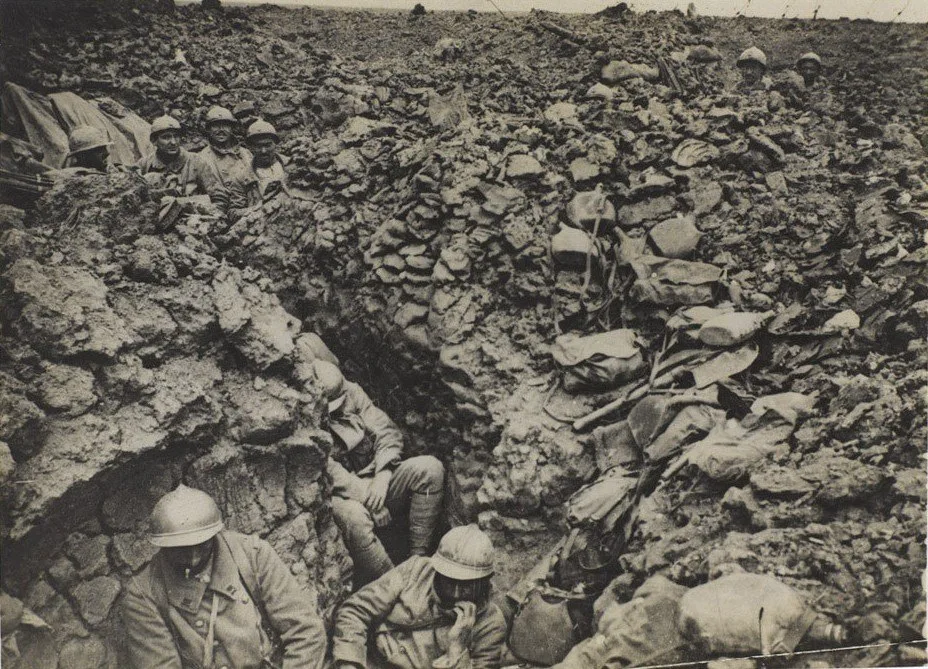
France went to war in 1914 in soft caps. Head wounds from shell fragments soon became one of the commonest injuries in the trenches, and Intendant-General Louis Adrian produced a steel helmet based on the shape of older helmets. It was approved in 1915 and issued to all soldiers from that winter.
The M15 Adrian was the first standard French steel helmet. More than twenty million Adrian helmets were made, and armies across Europe and beyond adopted it.

How it is built
- Shell. Mild steel, about 0.77 kg, made from several pieces: the bowl, a front visor and rear neck guard joined to it at a rim.
- Crest. A raised comb runs front to back over a large vent. The crest and badge slot added about 100 grams and took extra time to make.
- Liner. Six leather tongues on a corrugated metal band, which kept the shell off the head and absorbed some shock.
- Size. Shells are marked with a size letter, such as A.
Branch badges
A stamped badge is fitted to the front:
| Badge | Branch |
|---|---|
| Flaming grenade marked RF | Line infantry and cavalry |
| Bugle horn | Chasseurs |
| Grenade with crossed cannons | Artillery |
| Cuirass and helmet | Engineers |
| Anchor | Colonial troops |
| Crescent | North African units |
"RF" stands for République Française. Badges are easy to swap, so a rare badge on a common helmet needs a careful look.
Is it a WWI M15? Four checks
- Look for the joining rim. A separate rim where visor and neck guard meet the bowl means M15. A one-piece bowl means the 1926 model.
- Check the paint. Original WWI helmets are horizon blue, usually the darker shade, inside and out. Many were repainted during the war; khaki is correct for colonial troops.
- Look at the liner. Leather tongues on a corrugated band, often with aluminum spacers. A missing liner is common.
- Check the badge fitting. The badge should sit firmly in its slots with the same age as the shell. Replacement badges are common.
Foreign Adrians
Italy, Belgium, Romania, Serbia and Russia all used the Adrian, and the United States issued some. Italy made its own versions, and Belgium and Russia had their own patterns. They are covered on their own pages.
What M15 helmets sell for
Shells sell for around $225, and complete helmets with badge, liner and chinstrap for about $300–$400. Rare badges and period camouflage sell for more.
| Helmet | Where | When | Price |
|---|---|---|---|
| Early issue, infantry RF badge, repainted in period | Dealer, sold | Archive | $395 |
| Infantry shell, horizon blue | Dealer, sale price | Archive | $225 |
Single sales and asking prices, not a price guide.
Related helmets
Sources
- Adrian helmet: Wikipedia: design, insignia, colors and users
- International Military Antiques: liner construction, badges and prices
- Musée de l'Armée: adoption and issue
Was this page helpful?