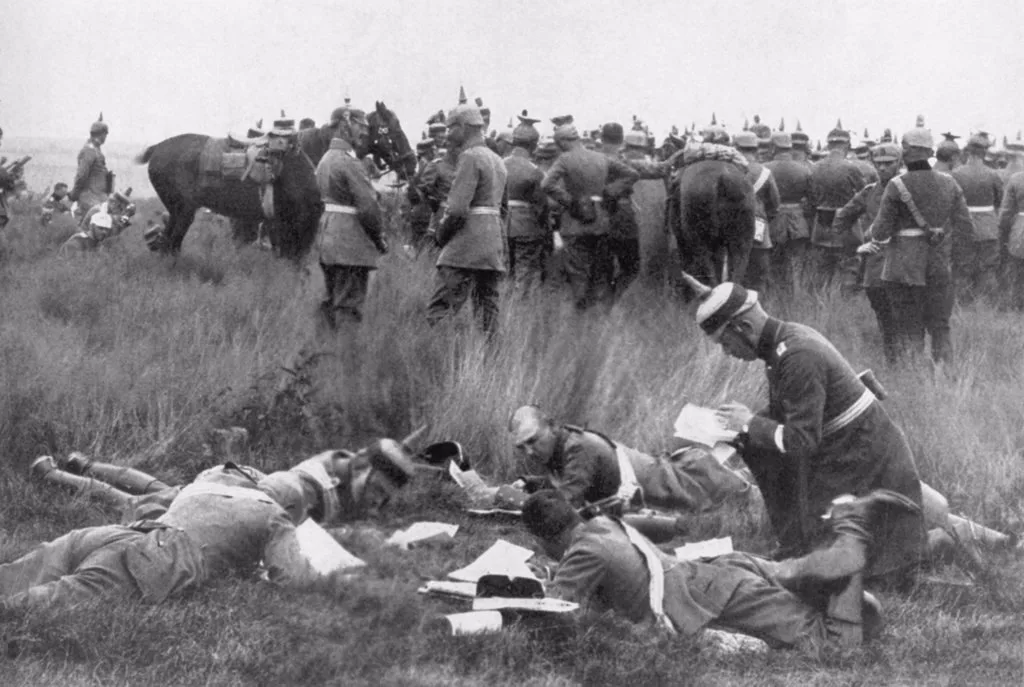
King Frederick William IV of Prussia introduced the spiked helmet for most of his infantry by cabinet order on 23 October 1842. Other German states and several foreign armies followed. By 1914 it was the standard headgear of the German army: hardened, lacquered leather with brass or steel fittings, a front plate showing the regiment's state, and a spike on top.
It looked imposing and protected very little. Within two years of the war starting it had been replaced at the front by the steel helmet.

The main types
- Leather, prewar. Hardened ("boiled") black leather with metal fittings. Officers' fittings were usually gold or silver plated.
- Artillery. A ball-shaped top instead of a spike, ordered in 1844 because the spike injured horses and damaged equipment.
- Model 1915. A simplified helmet with a removable spike. That September, troops in the front line were ordered to wear it without the spike.
- Wartime ersatz. Leather ran short, and helmets were made of sheet steel, then pressed felt and even paper.
Plates and cockades
The front plate shows the state or province of the regiment, most often the Prussian spread-winged eagle. Two cockades sit at the sides: the national red, black and white, and one in the state's colors. Bavaria was the last German state to adopt the helmet, in 1887.
Covers
From 1892 a cloth cover (Überzug) was standard on maneuvers and in the field. Regimental numbers on it were red until August 1914, then green. In October 1916 the cover color changed to field gray. Original covers are scarce. They sell well on their own.
Is it original and complete? Four checks
- Look at the leather body. Age crazing and wear are normal. A high-gloss refinish lowers value but is common on restored helmets.
- Check every fitting. Spike, plate, chinstrap and cockades are often replaced. Auction descriptions routinely note "reproduction cockades" or "reproduction chinstrap".
- Look inside. An original liner, maker stamps and regimental markings add a great deal.
- Match the parts. An officer's spike on an enlisted helmet, or a plate from another state, means a composite helmet.
What Pickelhauben sell for
Restored or composite enlisted helmets sell for a few hundred dollars. Complete original helmets, and especially officers' and cavalry helmets, sell for $1,000 or more.
| Helmet | Where | When | Price |
|---|---|---|---|
| Prussian officer's helmet | Skinner (Bonhams), sold | Aug 2025 | $1,057.50 |
| Prussian customs official, all original | Noble Numismatics, sold | Archive | A$900 |
| Prussian cuirassier, 19th century | eBay, sold | Aug 2025 | £1,675 |
Single sales and asking prices, not a price guide.
Related helmets
Sources
- Pickelhaube: Wikipedia: adoption, models, materials and covers
- Bonhams / Skinner, lot 1251
- Noble Numismatics, Stoyles collection
Was this page helpful?